
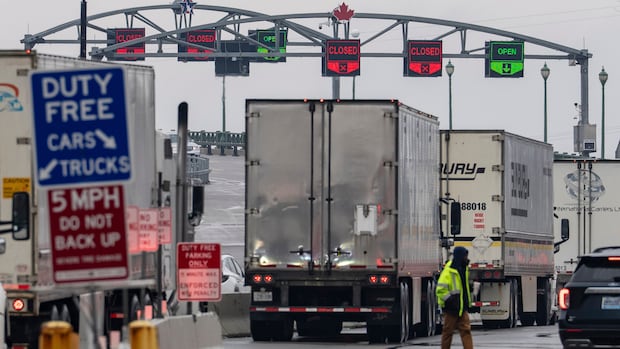
Enforcement regarding cross-border cargo has significantly increased during the Trump administration, resulting in heightened costs and delays that act as a deterrent to trade, according to shippers. Along the 49th parallel, a tariff barrier is emerging, with transport industry experts noting a surge in freight inspections and penalties as part of a stricter customs approach in the protectionist U.S.
Breanna Leininger, leading operations in the U.S. for Vancouver-based Pacific Customs Brokers, described the shift as monumental. She mentioned that the requests for documentation on shipped goods have multiplied by ten compared to previous years. Leininger, managing 5,000 customers engaged in cross-border shipments, highlighted a substantial increase in customs scrutinizing entries, which has become a daily occurrence.
Importers are finding themselves increasingly required to furnish extensive paperwork trails, including labor and manufacturing records, to demonstrate compliance with product classifications and trade agreements. The level of evidence requested, alongside the tariffed items, appears to evolve monthly, making it challenging for businesses to keep up.
Official data corroborates the narrative of stringent enforcement. U.S. Customs and Border Protection statistics indicate a projected 26% increase in audits this year compared to 2024. Audits involve reviewing importers’ records for adherence to tariff classifications, customs valuations, and free-trade agreement terms like the Canada-United States-Mexico Agreement.
In the first half of this year, U.S. customs authorities collected $70.6 million US in trade penalties by late July, marking a 169% surge from all of 2024. This six-month sum also reflects a 53% rise from the total penalties in 2025.
This intensified enforcement coincides with a growing trade conflict between Canada and the U.S., with both sides imposing new tariffs in recent weeks. The delays at the border and increased time needed for documentation sourcing contribute to escalating expenses and, in certain cases, discourage cross-border trade.
Alan Dewar, the executive vice-president at GHY, a Winnipeg-based customs brokerage, emphasized the significant financial burden imposed by these developments. He highlighted additional costs incurred by drivers stuck during delays, potential spoilage, and service charges for missed delivery deadlines.
Leininger added that while many have managed to navigate these challenges, some businesses have found the situation overwhelmingly difficult and have given up. U.S. Customs and Border Protection stated that it continuously evaluates and adjusts its trade enforcement strategies based on risk assessments, trade patterns, and legal obligations. Importers are reminded of their responsibility to exercise due care and provide accurate information to customs authorities.

