

Being the sole communicator in the universe can be quite isolating.
For those unaware, the quest for extraterrestrial life — particularly intelligent life — has been in progress for many years. Yet, up until now, it appears we are alone.
Astronomers employ two primary methods to search for life: they look for biosignatures, which are indicators of biological processes from the past or present (consider Mars rovers); and technosignatures, which signify technology developed by intelligent beings. The latter search predominantly relies on radio astronomy rather than optical methods, as any activities would occur at distances too vast for visual detection. In essence, astronomers are tuning in to sounds from the cosmos.
One of the leading organizations in this endeavor has been the SETI Institute. Established in 1984, it has been scanning the skies for radio signals that might be traveling through space to reach us. The organization focuses on star systems that host known exoplanets, but as of yet, no extraterrestrial signals have been found.
Recently, researchers from the Mountain View, California-based institute have devised an innovative approach to detect these signals, incorporating concepts from game theory. This new strategy not only examines where to search for signals but also when to do so.
Game theory is a mathematical discipline that explores decision-making in interactive scenarios, where the choices of each “player” or “agent” are interdependent. Each participant considers the strategy of the other while remaining unaware of their actions. The outcome is determined by the combined strategies of both players.
In the context of the SETI Institute, researchers are utilizing the “Schelling point” concept from game theory. A famous illustration from American economist Thomas Schelling involves two people planning to meet in New York City without any prior agreement on time or location. Both might arrive at Grand Central Terminal at noon, as it is a well-known meeting spot and a sensible time.
Now, apply this concept to the search for an alien civilization, focusing on the anti-solar point, an imaginary position in space directly opposite the sun (180 degrees away). Imagine a line extending from the sun through Earth into the cosmos.
What if an extraterrestrial civilization could observe Earth as it transits in front of the sun? What if they were aware of a planet orbiting our sun and directed a signal toward us?
We have identified the location — Earth — and the timing — during a transit.
In essence, we’re meeting at Grand Central at noon.
Voices in the void
This anti-solar approach was proposed years earlier but lacked sufficient funding to be pursued until now.
“I have been considering these concepts that have been circulating in literature for a long time,” stated Sophia Sheikh, a technosignature research scientist at the SETI Institute and lead author of the study. “Now, the anti-solar point idea is finally getting its moment in the spotlight.”
In their recent publication dated November 3, SETI Institute astronomers reported identifying 1.9 million radio signals through this method. However, after thorough filtering, they found none that corresponded to extraterrestrial technology — all the signals were of terrestrial origin. It appears that we humans, with our satellites and radio waves, are quite loud.
Although this specific section of the sky has been examined, it does not imply that there is nothing beyond it. The universe is vast.
According to Sophia Sheikh, they intend to continue utilizing this method for at least four more years.

The Sun and our solar system in relation to the Milky Way galaxy. The white circle indicates the area where the majority of exoplanets have been found with current telescopes. (NASA/JPL-Caltech/T. Pyle)
They are searching for what is known as a narrowband signal, which Sheikh likens to a “‘we are here’ … similar to an air horn in the radio spectrum.”
“It might contain information, or perhaps the signal we identify serves as a carrier wave. Essentially, the air horn indicates, ‘Hey, there’s something noteworthy here.’”
However, rather than envisioning astronomers donning headphones like Ellie Arroway in the 1997 film Contact, it’s actually computer programs that analyze the data.
The SETI Institute employs the Allen Telescope Array, consisting of 42 steerable 6.1-meter diameter telescopes at the Hat Creek Radio Observatory in California. This array has been utilized to search for extraterrestrial signals since the 1980s.

The Allen Telescope Array, the first radio telescope specifically designed for the search for extraterrestrial intelligence (SETI), is located at the Hat Creek Radio Observatory in northern California and comprises 42 antennas. (Simon Steel)
Science fiction?
The pursuit of extraterrestrial signals might seem like a plot from a science fiction story. However, given that our Milky Way galaxy is home to over 100 billion stars, many believe that there must be other life forms, especially since we now understand that most stars have at least one exoplanet.
Additionally, the Drake equation, formulated by American astrophysicist Frank Drake in 1961, sought to estimate the number of potentially communicative civilizations within the Milky Way.
The outcome relies on many unknown factors, but it is certainly not zero.
Adam Frank, a professor of astrophysics at the University of Rochester in New York, is also investigating technosignatures. He received NASA’s inaugural grant to explore non-radio technosignatures, focusing on chemical signatures or other signs of intelligent life.
He has noted how the search for extraterrestrial intelligence was not taken seriously in earlier times.
“The giggle factor, which lingered throughout nearly my entire career, has dissipated,” Frank remarked, alluding to the historical lack of seriousness regarding the possibility. “It never was logical.”
This sentiment is particularly valid following the initial discovery of exoplanets in 1992 and the identification of an exoplanet around a sun-like star in 1995.
In the event of a detection…
What would happen if a signal were detected?
Believe it or not, there are established protocols outlined by the International Academy of Astronautics. Beyond the essential step of confirming and validating the discovery, a critical guideline is: do not respond. (If you are familiar with 3 Body Problem by Liu Cixin, you understand the reasoning behind this caution.)
-
‘Weird’ interstellar asteroid yields no alien signals, resembles worlds beyond Neptune
-
Scientists skeptical about recent claims that signs of life were possibly detected on exoplanet
This isn’t necessarily a significant problem. Signals would traverse light-year distances. So, if we were to receive a signal from a star system 100 light-years away and decided to respond, it would take 100 years for our reply to reach the alien civilization, followed by another 100 years for their response to return to us. That totals 300 years just to say, “Hello.”
“Communication is not our top priority,” noted Frank.
Frank’s research focuses on identifying technosignatures by examining the chemical composition of exoplanets.
“For instance, we can analyze the atmospheres of distant planets for substances like chlorofluorocarbons… a chemical solely produced by human industry,” he explained. “You won’t find it naturally occurring in a biosphere.”
Ultimately, it may be more about finding solace in the knowledge that we are not alone.
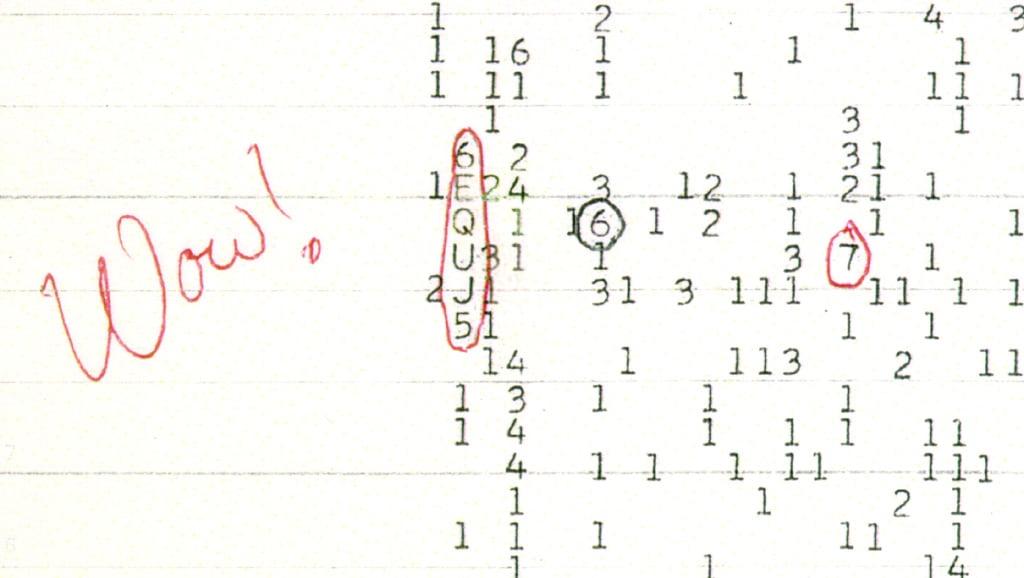
This image depicts the printout of a strong signal recorded at the Big Ear Radio Observatory in 1977. Astronomer Jerry Ehman encircled the unusual signal and wrote ‘Wow!’ in the margin. (Big Ear Radio Observatory and North American Astrophysical Observatory)
While a definitive radio signal indicative of an alien civilization has yet to be found, there was the renowned “Wow! Signal.” Detected in 1977 by the Big Ear telescope in Ohio, this powerful radio signal lasted for 72 seconds but was never observed again. Since then, there has been speculation that it may have originated from passing comets.
So, when could we expect to identify an alien signal?
“The optimistic view I like to share,” said Sheikh, “is that by the end of my career, we will have a clearer understanding of whether any radio signals in our galaxy are being emitted by technologically advanced civilizations.”

