
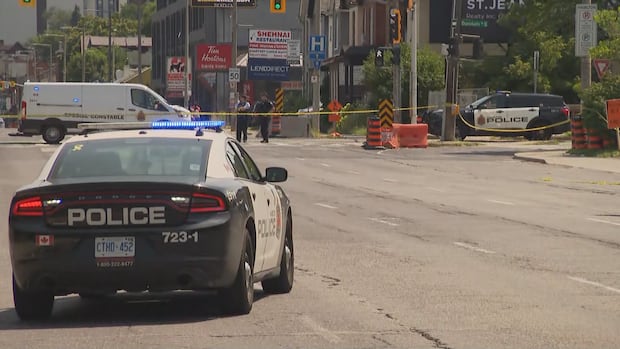
Last week, when CBC interviewed residents in downtown Hamilton regarding their feelings of safety in the city, the majority expressed at least a moderate sense of insecurity.
These individuals were taken aback to learn from a reporter that crime rates in Hamilton have remained consistently lower than both provincial and national averages over the past five years, according to data released by Statistics Canada in July.
The statistics indicate that Hamilton ranks below the provincial and national averages based on the crime severity index, which encompasses all Criminal Code violations, drug offenses, and other federal statutes.
Furthermore, Hamilton has experienced a continuous decline in the homicide rate over the past three years, remaining below provincial and federal levels since 2021.
Police Highlight Discrepancy Between Perception and Reality
Hamilton Police Service Chief Frank Bergen noted that there is a disparity between the actual data and the perceptions held by residents.
“Statistically, we can indicate that the crime severity index in Hamilton is moving in a positive direction, yet the perception of safety does not align with that,” he stated during a community safety summit in November.
At a separate community gathering in May, where concerns about the downtown area were voiced, police presented data showing that the average “crime harm” rate in the downtown region is comparable to that of the entire city.
Evelyn Myrie, a community advocate who moderated a panel at the November summit, suggested that one reason for the feeling of insecurity may be the bold nature of some recent offenses. She referred to the tragic deaths of Belinda Sarkodie and Harsimrat Randhawa, who were innocent bystanders struck by stray gunfire while waiting at bus stops.
In May, Daniel Mosannef and Samantha Henderson from Hamilton police’s Crime Information and Analysis team indicated that the perceived gap in safety could be linked to issues like “social disorder,” which encompasses visible drug use and homelessness, as well as individual experiences in public spaces and the influence of social media.
Rise in Hate Crimes and Youth Involvement in Violent Offenses
An exception to the overall decline in crime in Hamilton is the rise in hate crimes, which saw an increase year-over-year in 2024 and again in 2025.
A report from July indicated that 2025 marked the highest number of reported hate crimes and incidents within the city over the past ten years, climbing from 82 reports in 2020.
Another significant exception involves youth participation in violent offenses, specifically among individuals aged 12 to 17.
In an August interview, Mosannef informed CBC Hamilton that there have been slight yearly increases in the number of young people engaging in criminal activities since 2020.
In 2025, he reported 1,252 instances of youth involvement in crime, with 689 categorized as violent offenses. Compared to 2019, this reflects approximately an eight percent increase in overall youth crime, but nearly a 40 percent rise in violent offenses among this age group.
Police also evaluate the level of harm associated with crimes, Mosannef explained, noting that this figure rose from 84,000 in 2019 to 93,564. Although these scores may seem counterintuitive, he emphasized that the increase is “significant.”
Analyst Attributes Youth Violent Crime Increase to Multiple Factors
This year, police have issued warnings about young individuals participating in bear spray incidents, with charges against children as young as 11. Young people in the area have also been charged for high-profile smash-and-grab thefts. Among the eight homicide victims in Hamilton this year, four were teenagers, and one was 21. In at least two shootings that resulted in teenage fatalities, police indicated that the suspects were also teenagers.
“Clearly, we recognize that there is an issue,” Mosannef remarked, noting that this situation extends beyond Hamilton. “This is a topic that criminologists around the world are discussing and continue to address.”
“It would be inappropriate for me to make any definitive statements about a singular solution,” he added, but factors may include socioeconomic disparity, gang recruitment, and the influence of social media.
“This is not solely a law enforcement issue,” Mosannef concluded. “It is fundamentally a problem involving systems, our communities, the province, and the nation as a whole.”

