

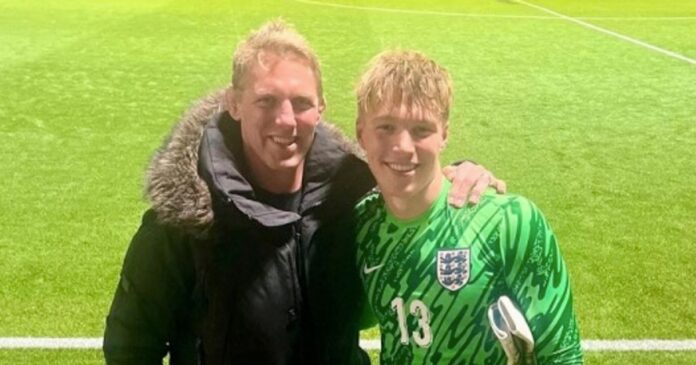

England’s Lewis Moody, a World Cup champion, observed his son playing for the national team just days after publicly disclosing his motor neurone disease (MND) diagnosis. The former England captain shared the devastating news in an interview less than a week ago.
MND has claimed the lives of rugby stars Doddie Weir and Rob Burrow, and Moody has acknowledged that he is not prepared to fully comprehend the implications of his diagnosis. The 47-year-old initially experienced weakness in his shoulder during a gym session, leading to scans revealing nerve damage in his brain and spinal cord due to MND.
Part of the iconic 2003 World Cup-winning squad, Moody is now witnessing his son, Dylan, begin his own international journey, albeit in a different role. The 17-year-old secured his first professional contract with Southampton earlier this year and made his debut for England in September. On Thursday, he returned to the field for the Three Lions under-18s, contributing to a 1-0 victory over France at St George’s Park.
Dylan Moody came off the bench for the youth team, which also featured Elijah Upson, son of Matthew Upson, and Reigan Heskey, son of Emile Heskey. The former scored the decisive goal in stoppage time.
Moody Sr praised his son, a young goalkeeper, on Instagram with two posts. In the first post, he described Dylan as a “rather large legend,” followed by another post commending him as a “little warrior.”
The England legend has been candid about his medical condition, stating that he experiences minimal discomfort and hopes to maintain a normal life for as long as possible. However, he admits to feeling some fear about the uncertainties of the future.
Despite being emotionally affected by the MND diagnosis, Moody expressed that he currently feels physically well and capable of performing daily tasks. He emphasized his determination to continue living normally while acknowledging the challenges that lie ahead.
Moody shared his reluctance to fully confront the future implications of his condition, acknowledging the understanding of where it may lead but expressing a current unwillingness to deeply contemplate it.