

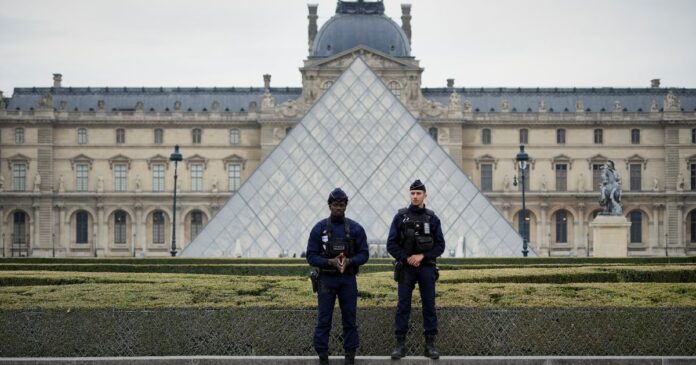

An extraordinary heist lasting minutes, where daring thieves stole invaluable items from the renowned Louvre museum, was made possible by significant security lapses, according to French officials. The robbers, still at large, managed to swipe items of immense historical value from the Parisian art gallery within a mere seven minutes by effortlessly entering and exiting after breaking glass displays.
The incident has sparked national outrage, prompting inquiries into how the perpetrators breached security measures at one of the world’s most safeguarded museums. The Louvre’s ongoing construction for the government’s Nouvelle Renaissance project left a vulnerable section of the facade facing the River Seine, which the thieves exploited to their advantage.
Reportedly, four masked individuals infiltrated the museum through the construction site early in the morning, using an unattended cherry picker to access the Apollo Gallery jewel room on the first floor unnoticed. The thieves then utilized a battery-powered disc cutter to breach the glass panes, revealing the security shortcomings as highlighted by the Confederation of Fire Protection Associations Europe.
While an alarm system was in place, a local alarm had recently malfunctioned, and the wider alarm lacked specificity on the breach location. Despite encountering museum guards upon entry to the Apollo Gallery, the robbers managed to evade them without resorting to violence, proceeding to smash the cases containing the precious jewels.
A critical oversight was the absence of CCTV surveillance in a specific area near the Mona Lisa, allowing the thieves to exploit a blind spot and depart undetected. After ransacking the jewels, the thieves attempted to set fire to their getaway vehicle but were thwarted by a vigilant museum staff member.
Although the staff intervened, the thieves fled on scooters before authorities could apprehend them. The Louvre, no stranger to high-profile thefts, has a history of security breaches, including the infamous disappearance of Le Chemin de Sevre by Camille Corot in 1998, which remains unsolved despite security enhancements following the incident. Efforts are underway to track down the elusive thieves responsible for the recent heist.