
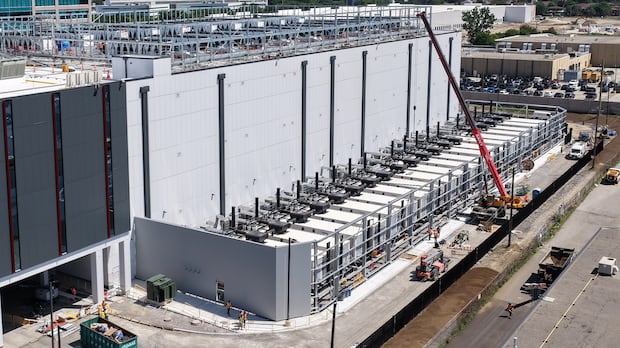
Ontario Premier Doug Ford unveiled the province’s fresh data center strategy on Thursday, emphasizing its commitment to safeguarding Canadians’ data within the country. The strategy is built on three core pillars: promoting economic growth, ensuring data protection and sovereignty, and fostering community investment for public trust.
During the announcement in Guelph, Ford highlighted that the government’s new data center playbook aims to boost economic growth, increase tax revenues, and create numerous job opportunities while upholding regulatory standards for data center operations. The framework mandates data centers to cover their entire electricity consumption costs, encouraging them to develop their power generation sources. It also establishes a distinct rate category for large new data centers, ensuring they pay higher rates compared to existing industrial users, without burdening Ontario families with additional costs.
Ford emphasized that financial incentives would not be granted to attract investments, as the province’s framework aligns with its artificial intelligence (AI) strategy. The AI strategy is anticipated to generate substantial economic growth, amounting to $122 billion by 2035, and create around 17,000 new jobs annually.
The announcement coincides with ongoing discussions in various municipalities across Ontario regarding moratoriums on data centers. Oakville recently imposed a one-year moratorium, while Mississauga is set to vote on a similar measure in September.
Green Party of Ontario leader Mike Schreiner, who called for a halt on data centers, expressed concerns about the impact of data centers on local water resources. He was joined by Ilham Abdulkadir from Wellington Water Watchers, who emphasized the substantial land, energy, and water requirements of data center infrastructure.
Amidst these discussions, Ontario’s Minister of Economic Development, Vic Fedeli, affirmed the province’s commitment to prioritize data centers employing closed-loop systems to minimize water consumption. Ford reiterated this stance, emphasizing the preference for data center constructions using closed-loop systems with minimal water usage.
Schreiner criticized the newly introduced playbook, citing a lack of specific regulations and details. He stressed the importance of strong protections for communities against data centers, advocating for a moratorium until stringent regulations are in place to safeguard people and communities.
Looking ahead, Waterloo region is assessing the local impacts of data centers, with Coun. Colleen James tabling a motion to prepare an informative report for the Region of Waterloo council. The report aims to shed light on the development, economic implications, and environmental effects of data centers, with completion expected early next year.

