
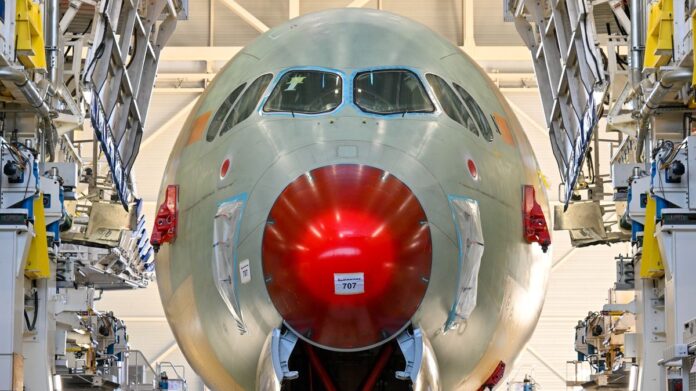
Australia’s flagship airline, Qantas, has unveiled the initial images of its groundbreaking ultra-long-range Airbus that is set to make aviation history with a 22-hour non-stop flight. This innovative aircraft will establish direct routes from Sydney to London and New York by 2027, marking a new milestone for the longest commercial flight ever operated.
Currently under construction in Toulouse, France, the aircraft’s essential components, such as the fuselage, wings, and landing gear, have been successfully assembled. Qantas introduced this significant progress at its annual general meeting in Brisbane, emphasizing the aircraft as a revolutionary advancement for international air travel.
The A350-1000ULR will play a vital role in Qantas’s ambitious Project Sunrise initiative, aimed at connecting Australia’s east coast with major global cities without layovers. Each flight is anticipated to last up to 22 hours, offering travelers a time-saving advantage of up to four hours compared to existing one-stop routes.
Following the component assembly, the jet is scheduled to be transferred to a specialized hangar for the installation of engines and flight equipment before commencing an intensive testing phase in 2026. Qantas CEO Vanessa Hudson expressed her enthusiasm for this achievement, highlighting its significance in realizing the airline’s global aspirations.
Vanessa Hudson stated, “Given Australia’s strategic position, Qantas has a legacy of shattering aviation barriers. Project Sunrise will not only conquer the challenges of distance but will also revolutionize the way our passengers explore the world.”
The aircraft’s exceptional range is made achievable through a supplementary 20,000-liter rear fuel tank and cutting-edge onboard systems, ensuring peak endurance, comfort, and safety. With the launch of Project Sunrise in 2027, non-stop flights across vast distances will become a reality, defying previous limitations.
To address the physical demands of extended travel, Qantas has collaborated with Australian designer David Caon and researchers from the University of Sydney’s Charles Perkins Centre. Their team, including sleep experts, has devised tailored lighting schemes and meal timing strategies to mitigate jet lag.
Differing from the standard A350-1000 model accommodating over 300 passengers, Qantas’s variant will only seat 238 travelers, offering enhanced personal space. Introducing a unique “Wellbeing Zone” nestled between Premium Economy and Economy classes, passengers will have access to stretch handles, guided exercise screens, a hydration station, and light snacks for a rejuvenating flight experience.
Named after Qantas’s historic “Double Sunrise” flights during World War II, Project Sunrise embodies the airline’s legacy of pioneering achievements in air travel. Through this new generation of aircraft, Qantas is revitalizing its pioneering spirit, pushing the boundaries of aviation once more.
Additionally, Qantas revealed the introduction of a new domestic travel class, Economy Plus, featuring extra legroom, priority boarding, and designated overhead storage. The upgrade will be purchasable starting February, with complimentary access offered to elite frequent flyers.
The initial delivery of one of the 12 A350-1000ULR aircraft is anticipated by late 2026, paving the way for commercial operations in early 2027. Qantas expressed tremendous enthusiasm for the project, labeling it as a transformative moment for international aviation.

