
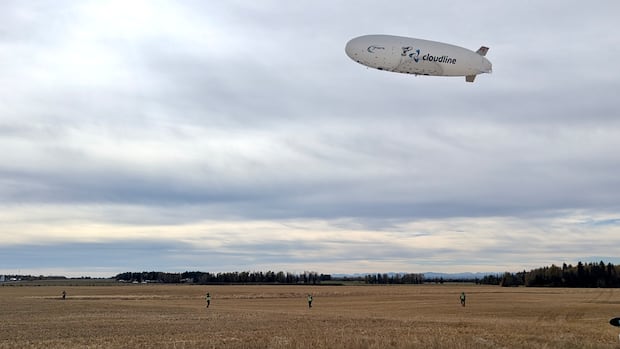
In central Alberta last week, an unusual sight caught the attention of onlookers, sparking curiosity about a 20-meter airship floating in the sky. While the sight of a blimp is common at sporting events, spotting one in rural Alberta is a rare occurrence.
The airship in question was a solar-powered aircraft, comparable in size to a school bus, conducting aerial survey tests near Rocky Mountain House, approximately 200 kilometers southwest of Edmonton. A team from Cloudline, a South African aerospace company that built the airship, in collaboration with its Canadian partner, 3 Points in Space Media, carried out flight trials at the Rocky Mountain House Airport.
According to Sean Adams, the CEO of 3 Points in Space Media, the airship operates similarly to a helium party balloon but with advanced features that make it an autonomous aircraft. Adams highlighted the novelty of the technology, emphasizing its capability to integrate control systems with the airship.
Pre-flight preparations involve filling the airship’s envelope with helium and performing diagnostic checks while it is tethered. Once cleared, the aircraft is released for calibration runs before embarking on long-distance survey flights. The airship, classified as a remotely piloted aircraft system, utilizes automated flight controls for data collection purposes in remote areas like monitoring pipelines and infrastructure.
Spencer Horne, the CEO of Cloudline, noted the airship’s significant payload capacity, allowing it to carry heavier camera and LiDAR sensors over extended distances compared to standard drones. Despite its advantages, Adams acknowledged that crewed aircraft are more suitable for extreme weather conditions.
The research initiative, supported by TC Energy, aims to gather diverse data types efficiently and quietly using the airship. The modernization of airship technology represents a revival of historic aviation, bridging past achievements with present innovation.
Local residents in Rocky Mountain House expressed excitement at the presence of the airship, generating considerable interest and social media engagement. The airship’s operations span international locations, and the upcoming testing in northern Ontario will focus on assessing its performance in cold weather and Arctic environments.

