
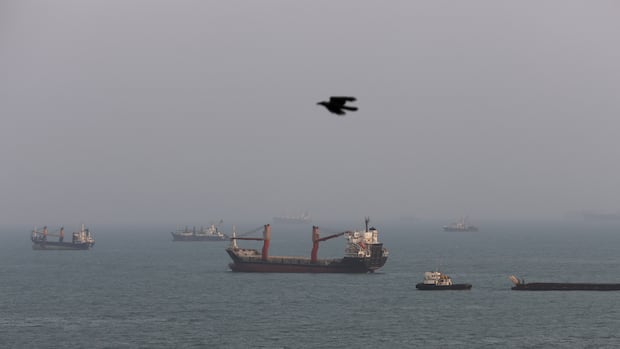
President Donald Trump stated on Tuesday that there were no ongoing discussions with Iran and emphasized that the Strait of Hormuz remained open, countering Iran’s claim that the crucial water passage was closed to shipping. The diminishing likelihood of a resolution to the nearly six-month conflict led to a rise in oil prices, a decline in stock markets, and increased borrowing costs for major economies, including the U.S., due to concerns about long-term inflationary effects of the crisis.
Following the expiration of a temporary ceasefire agreement on Monday, a senior Iranian official indicated that Iran was transitioning to a “fully offensive” military stance amidst the diplomatic impasse, although there were no reported fresh attacks by either side on Tuesday. Trump, in a post on Truth Social, asserted that there were no ongoing or scheduled talks with Iran, confirming the full implementation of the Naval Blockade and the operational status of the Hormuz Strait, with the removal or detonation of all water mines.
Jared Kushner, Trump’s son-in-law and special envoy, had expressed optimism on Monday, suggesting that talks with Iran were still active and potentially more intensive than before. The conflict, initiated by joint U.S.-Israeli strikes on Iran, has evolved into a deadlock, with Iran threatening shipping in the strait, and Washington warning of potential renewed attacks if negotiations fail to yield a lasting settlement. One of the primary U.S. objectives is to prevent Iran from obtaining a nuclear weapon, a goal that experts believe will be challenging without addressing the enriched uranium believed to be hidden at previously targeted sites.
Despite Trump’s positive outlook on the Gulf situation, disruptions in shipping persisted as countries reported ongoing incidents. The United Arab Emirates’ Defence Ministry disclosed the detection of two ballistic missiles launched from Iran, marking the first such occurrence since a May 4 assault on the Fujairah port. The UAE suspended various activities with Iran, citing regional tensions that jeopardize peace and security.
A report from the United Kingdom Maritime Trade Operations noted that a vessel transiting the Strait of Hormuz was hit by an unidentified projectile on Tuesday, resulting in engine room damage and a crew member injury. The Omani Coast Guard was providing assistance to the affected crew, with no immediate response from Tehran. Iranian negotiator Mohammad Baqer Qalibaf emphasized that the strait would remain closed until the U.S. fulfilled the conditions of an interim deal signed in June.
Iran’s readiness for dialogue with the U.S. was highlighted by Mohammad Mokhber, an adviser to Iran’s supreme leader, who emphasized that negotiations should not be misconstrued as capitulation. Mokhber reiterated Iran’s commitment to defending its security, dignity, and allies while rejecting the notion that military pressure and sanctions could weaken its resolve.
The conflict has resulted in significant casualties, particularly in Iran and Lebanon, with Iran conducting attacks on U.S. military installations and infrastructure in various countries. Brent crude oil prices surged during the conflict, reaching $126 per barrel, a substantial increase from pre-war levels. The U.S. administration reiterated the possibility of imposing additional economic sanctions on Iran, signaling potential escalations in the future.

