
Lucas Brehaut anticipated significant interest in his research but encountered unexpected challenges from the wildlife in Newfoundland’s wilderness. As a wildfire research scientist with the Canadian Forest Service, he focuses on studying forest regrowth in Atlantic Canada post wildfires, which are becoming more prevalent despite the region’s cooler and wetter climate compared to the rest of the country.
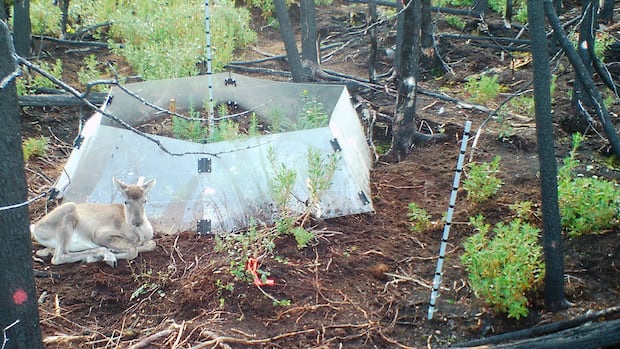
Following a forest fire near Grand Falls-Windsor in 2022, Brehaut embarked on a study to observe forest regeneration in a warming planet due to climate change. To simulate the effects of a warmer environment, he and his team had to transport and install 19 open-top chambers (OTCs) resembling mini greenhouses around planted seedlings in the forest. These chambers can elevate temperatures by one to three degrees and are currently in the third year of a five-year study.
Despite expecting challenges such as difficult terrain and harsh weather, Brehaut faced unexpected disruptions during a routine check-in in September 2023. Wildlife like caribou, moose, black bears, wolves, rabbits, and owls were found interfering with the research equipment. Surveillance cameras initially installed for monitoring snow depth revealed the culprits damaging the chambers and even stealing temperature sensors.
Of the 19 sites, 11 had suffered damage, with animals not only trampling the structures but also, in some instances, absconding with the sensors. Brehaut, familiar with the struggles at site number four dubbed “The Problem Child,” expressed disappointment but also understanding towards the wildlife’s actions, acknowledging their habitat rights.
Kaitlyn Gaynor, an assistant professor at the University of British Columbia, explained that animals’ curiosity towards foreign objects stems from their natural instincts, especially for intelligent species like bears. The unfamiliar scents left behind by researchers on equipment can attract animals, leading to interference. Gaynor recommended minimizing disruptions by swiftly entering and exiting research sites, reducing human scents, and concealing equipment.
Animal interference in research is a global occurrence, as Gaynor has encountered similar issues during fieldwork in Mozambique, where baboons, hyenas, and elephants disrupt research activities. She highlighted that animals, rather than technical malfunctions or theft, pose the most significant threat to equipment integrity.
Brehaut also faced challenges from human interference, with winter visitors inadvertently damaging his research sites with snowmobiles. Despite the setbacks, Brehaut remains dedicated to his research, understanding that coexisting with wildlife in their natural habitat comes with its share of disruptions and challenges.

