
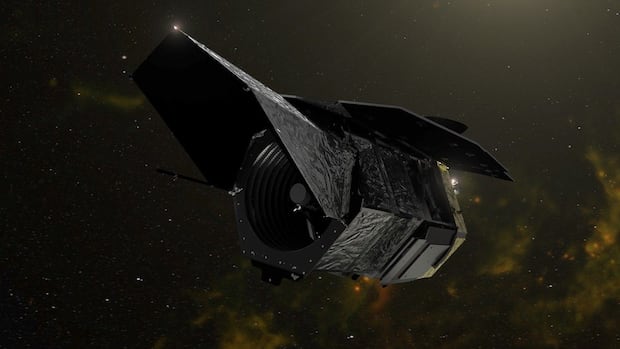
At 7:26 a.m. on Sunday morning, a new space telescope is set to launch from Cape Canaveral, Florida, atop a Falcon Heavy rocket. The Nancy Grace Roman Space Telescope, honoring NASA’s first chief astronomer and known as the “mother of the Hubble Space Telescope,” will embark on a mission to explore the mysteries of the universe from a distance of 1.5 million kilometers at the L2 point where gravitational forces maintain a stable orbit. The telescope’s initial five-year mission may be extended beyond that period.
The addition of the Nancy Grace Roman Space Telescope to the existing array of telescopes in orbit, such as the Hubble Space Telescope and the James Webb Space Telescope, is justified by its unique capabilities. Equipped with a 2.4-meter mirror similar to the Hubble, the telescope also features a coronagraph to block starlight, enabling the detection of planets orbiting distant stars. Additionally, its Wide Field Instrument, as sensitive as the Hubble, can capture images over an area 100 times larger, significantly enhancing observational capabilities.
With the capacity to resolve billions of stars, the telescope’s advanced camera will facilitate a wide range of sky and stellar surveys, offering unprecedented insights. Scientists are eager for the groundbreaking discoveries expected from the Nancy Grace Roman Space Telescope.
One significant focus of the telescope will be the search for exoplanets, aiming to unravel the uniqueness of our solar system and explore other planetary systems. Employing methods like the transit technique, which involves monitoring stars for planet crossings, the telescope will expand on the achievements of previous missions like the Kepler Space Telescope. The telescope’s vast observational scope is anticipated to lead to the discovery of a substantial number of transiting exoplanets, revolutionizing our understanding of planetary systems.
Moreover, the telescope will utilize the microlensing method to delve even deeper into the exploration of exoplanets, particularly emphasizing the search for Earth-like planets. This innovative approach, combined with its comprehensive capabilities, is poised to advance our knowledge of planetary systems significantly.
In addition to exoplanet research, the Nancy Grace Roman Space Telescope will investigate dark matter and dark energy, two enigmatic components that dominate the universe. By studying the distribution and quantities of dark matter in galaxies and globular clusters, the mission aims to shed light on these elusive substances and their impact on cosmic structures. Furthermore, the telescope’s observations will contribute to the understanding of dark energy, which drives the expansion of the universe, offering valuable insights into cosmological phenomena.
The forthcoming launch of the Nancy Grace Roman Space Telescope heralds a new era of discovery and exploration in astronomy, promising groundbreaking insights into the universe’s mysteries.
[Link to source article]

