
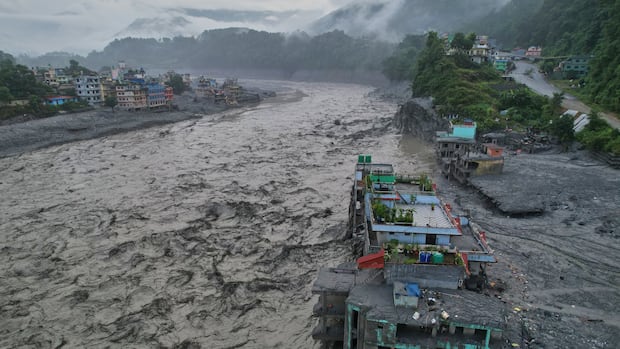
Authorities in Nepal issued a warning of potential new flooding on Sunday and advised residents in flood-affected regions to stay vigilant as water levels in the Bhotekoshi River surged. Notifications about flood warnings were dispatched to people’s mobile devices early on Sunday while rescue teams labored to clear a vital highway linking Kathmandu to one of the areas most severely impacted by the devastating floods that occurred on Wednesday, claiming a minimum of 800 lives and leaving over 3,000 individuals missing in Nepal and Tibet.
The recent alerts came after Chinese authorities notified Nepalese officials of an escalation in water flow upstream, as mentioned by Dharam Raj Uprety, the head of Nepal’s National Disaster Risk Reduction and Management Authority. The Chinese state news agency Xinhua, citing the Ministry of Water Resources, reported that a new lake formed post-Wednesday’s floods in the high mountains had mostly drained. However, the ministry cautioned that a crater situated 5.6 kilometers upstream, containing an estimated 1.4 million cubic meters of water, still posed a risk and necessitated close monitoring.
Nepal’s disaster agency disclosed on Sunday that the death toll had risen to 788 with 2,502 individuals missing, while Chinese authorities documented 16 fatalities and 546 missing persons on the Chinese side of the border. The missing individuals encompassed numerous people from various countries who were in the region for work, mountain visits, or pilgrimages to a sacred peak. Chinese state media revealed that 261 foreigners, including over 100 Nepalis and others from worldwide locations, were missing in Tibet.
Canada’s foreign affairs minister, Anita Anand, confirmed on social media Saturday that a previously missing Canadian had been found safe. Anand highlighted that 31 Canadians remained unaccounted for, with the number subject to change as new information surfaces.
Families in Canada are seeking the government’s assistance, notably Seema Rawla, whose brother, Sumit Rawla, is among the missing individuals. Seema, a Canadian permanent resident from the Vancouver area, expressed deep concern as her brother ceased communication immediately after the flooding in Nepal. She emphasized the emotional turmoil and the perceived need for more support from the Canadian government to aid families in similar situations. Rawla and other Canadian families with missing loved ones have appealed for resources like thermal and infrared cameras to be shared with Nepal, as well as the establishment of dedicated points of contact for each family.
Rescue operations are ongoing at five hydroelectric projects, including a significant initiative at the Upper Trishuli complex, where authorities received information suggesting about 350 individuals might be trapped inside a tunnel. Approximately 10,000 Nepali troops are engaged in tunnel rescue efforts alongside specialists from China and India, as confirmed by Uprety from Nepal’s National Disaster Risk Reduction and Management Authority.
In the aftermath of the devastating floods, some residents in Nepal’s worst-hit region, Dhading, have started returning to their destroyed homes to salvage belongings. The scenes of devastation include homes with washed-away walls, individuals searching for salvageable items in the mud, and a man rescuing his chickens from the disaster. Additionally, efforts are underway to assess the damage at a severely impacted power plant serving thousands of people across multiple districts.
The impact of Wednesday’s flash floods, triggered by a glacial collapse in the Himalayan region, has underscored the vulnerability of Nepalis to climate change. The catastrophic event resulted from a collapse of the bedrock beneath a glacier, causing a surge in river levels that ravaged structures and landscapes in Tibet and Nepal. Nepal’s foreign affairs minister emphasized the urgent need for global climate action, citing Nepal’s disproportionate exposure to climate change impacts despite its minimal contribution to global emissions.
While the direct link between global warming and the recent catastrophe is still being assessed, experts have highlighted the heightened risk of such disasters in regions like the Himalayas due to rising temperatures associated with human-induced climate change. The urgent need for climate mitigation measures has been underscored by the tragic events in Nepal and Tibet.

