
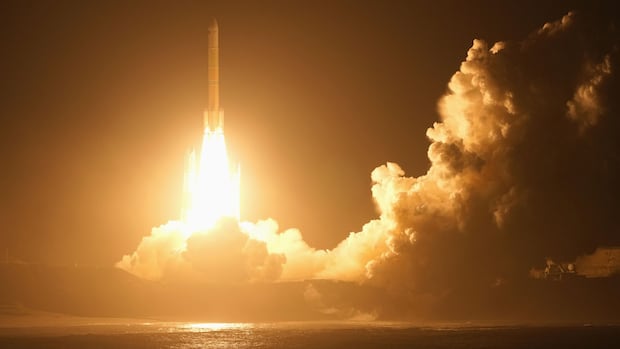
A Japanese spacecraft has embarked on a mission to Mars to explore its enigmatic moons and retrieve samples, with the collaboration of five international space agencies. The mission aims to land a robotic prospector and a rover on Phobos, one of Mars’s two small moons. The Japan Aerospace Exploration Agency successfully launched the spacecraft from Tanegashima Island, marking a significant milestone in the project.
While previous missions have landed on Mars, this endeavor marks the first attempt to explore Phobos and its companion, Deimos, as well as collect samples from the Martian system. If successful, samples containing dust, soil, and rocks from Phobos will reach Earth by 2031.
Phobos, a small, irregularly shaped moon, holds key insights into the formation of Mars’s moons and potentially other moons in the solar system. The mission, named MMX (Martian Moons Exploration), boasts a sizeable five-ton spacecraft that will rendezvous with Phobos before deploying the French-German rover, Idefix.
Idefix, a compact rover, will land on Phobos and operate as a scouting tool for safe sample collection. The rover’s primary task is to assess the terrain and conditions for the subsequent descent of the stationary lander in 2028 or 2029.
The lander will spend a brief period on Phobos, gathering samples before studying Deimos during flybys. The ultimate goal is to return the samples to Earth in 2031 for extensive analysis, shedding light on the origins of Mars’s moons and potential insights into planetary formation.
Scientists are eager to uncover the mysteries of Mars’s moons and their formation, which could provide valuable information about the evolution of the Red Planet and the possibility of past life. The mission represents a significant step towards understanding planetary and moon formation, with potential implications for future Mars exploration and the search for extraterrestrial life.
Japan’s investment in the mission, alongside contributions from NASA, the French Space Agency, the German Space Agency, and the European Space Agency, underscores the global effort to unlock the scientific treasures hidden within the Martian system. China and NASA also have ambitious plans for Mars sample return missions, setting the stage for a competitive race to unravel the mysteries of our neighboring planet.

