
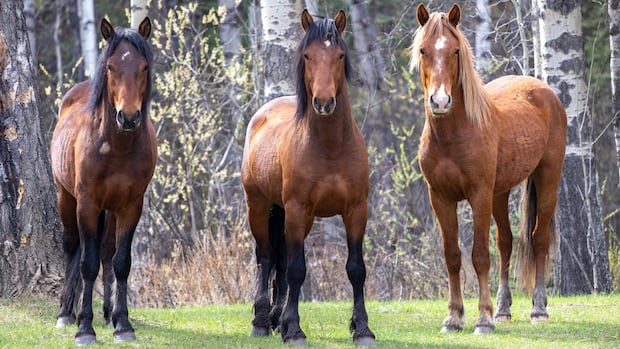
Health Canada has given the green light for testing a birth control vaccine on free-roaming horses in Alberta. The Alberta government deems managing horse populations crucial to prevent detrimental impacts on grazing areas for livestock and wildlife, as certain regions have seen horse numbers rise to concerning levels.
Contraception is highlighted in Alberta’s feral horse management framework as a method for population control, alongside strategies like removal from the wild and adoption. In late August, the Alberta government obtained a “research authorization” from Health Canada to use the contraception vaccine SpayVac-Equid on feral horses for study purposes only, not for general use.
The government is currently assessing the approval details regarding horse contraception and is collaborating with stakeholders to implement management actions in a safe and science-based manner. The latest feral horse survey in Alberta identified a record-high count of 2,072 wild horses in six equine management zones, with some zones showing unsustainable population levels.
A previous contraception pilot project initiated in 2014 by the province and the Wild Horses of Alberta Society utilized a vaccine called ZonaStat-H for population control. However, the project revealed challenges such as high costs, difficult terrain for administration, and the need for a significant portion of the female horse population to receive birth control to observe noticeable reductions.
The current strategy involves capturing horses, administering the vaccine manually, and releasing them back into the wild, with marked vaccinated horses for identification. The new contraception method using SpayVac-Equid is expected to have a high success rate, prevent conception for several years without altering herd dynamics, and eliminate the need for booster shots.
The Wild Horses of Alberta Society plans to launch the contraception project this fall, aiming to control horse populations effectively while ensuring the animals remain on the land. The society also engages in rescuing and rehabilitating horses, offering them for adoption to provide a sustainable solution for managing wild horse populations.

