
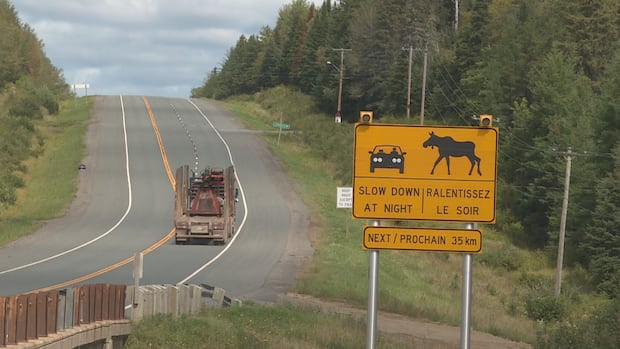
On a dark Saturday evening in late August, the Chaleur Lightning hockey squad had just finished an exhibition match against the Miramichi Timberwolves and boarded their team bus for the journey back to Bathurst. Assistant coach Alex Ouellet recounted hearing the driver gasp shortly into the ride. “It happened within the first few minutes,” Ouellet described. “I glanced up and saw a figure ahead of us, followed by a loud crash.” The team bus had collided with a moose on the highway, but fortunately, everyone on board, including players and coaches, emerged unscathed, except for the driver who sustained minor scratches.
Like numerous residents of New Brunswick who have encountered or narrowly avoided large animals on the road, Ouellet and the team are unlikely to forget the incident anytime soon. “I will certainly be mindful of it every time I travel those roads,” Ouellet remarked, particularly during evening and nighttime journeys. Coincidentally, the province revealed plans that same week to introduce two new wildlife crossings along that exact highway segment.
The province employs various strategies to deter moose from straying onto roadways, such as wildlife fencing and wildlife crossings or tunnels. Transportation Minister Chuck Chiasson mentioned that the decision on where to implement these measures is based on collision data provided by law enforcement. While 331 kilometers of New Brunswick highways are currently fenced on both sides to prevent wildlife incursions, the province has also constructed 82 wildlife crossings, including two newly installed tunnels on Route 8 between Miramichi and Bathurst.
These tunnels, more than four meters high and wide, comprise 11 prefabricated concrete sections. Chiasson likened their size to being large enough for a tractor-trailer to pass through. Wildlife ecologist Graham Forbes, who led research on the impact of wildlife tunnels 15 years ago, noted that animals need to find the tunnels intuitive to use them effectively. He explained that the design of the fences funnels animals towards the underpasses, making it easier for them to navigate the area.
Forbes discovered that the tunnels were not only utilized by large animals but also by various other species like beavers, ducks, bats, skunks, and raccoons. Despite the presence of wildlife tunnels, the Department of Transportation has not observed a significant decrease in collisions, with 409 recorded in 2024, including 65 causing injuries and one fatality. Chiasson emphasized the department’s commitment to enhancing safety for travelers through strategic mitigation efforts, which may include brush clearing to improve visibility.
Ouellet acknowledged that the Chaleur Lightning team will continue to traverse the same highway stretch for games. He expressed hope for additional fencing in the area but acknowledged the challenges of preventing every collision. “You try to make the best of a tough situation and implement the most preventive measures you can,” Ouellet concluded.

